
Overview
Educational psychology is the science of learners and learning, drawing on rigorous research to apply psychological principles to educational problems. Educational psychologists study the factors that shape student learning, engagement, and motivation, including biology, individual differences, development, and social and contextual influences. The field also depends on the methods that produce this knowledge: tests and measurements, statistics, and research design. Our graduate coursework is built to teach you both what the field knows and how that knowledge is produced.
Our graduate programs are designed to prepare individuals for employment in research, teaching, and service settings. The coursework includes topics such as development, cognition, motivational and social factors, individual differences, measurement, statistics, and research. The Master of Science (M.S.) degree in Educational Psychology with a concentration in General Educational Psychology is a planned program that requires completion of 35 hours of coursework.
We offer both face-to-face and online options to accommodate diverse learning preferences and schedules.
Curriculum
Educational Psychology Major Core (10 hours)
- EPY 6214 Educational and Psychological Statistics
- EPY XXXX Educational Psychology elective in consultation with advisor
- EPY 8263 Psychological Testing in Educational and Related Settings
General Educational Psychology
Concentration Requirements (19 hours)
- EPY 6033 Applications of Learning Theories in Educational and Related Settings
- EPY 6073 Personal and Motivational Factors in Education Related Settings
- EPY 6513 Introduction to Research in Educational Psychology
- EPY 8214 Intermediate Educational and Psychological Statistics
- EPY 8223 Psychological Foundations of Education
- EPY 8293 Cognitive and Affective Development
Related Electives or Thesis Hours (6 hours)
Non-thesis option
- EDF 9453 Introduction to Qualitative Research
and ONE EPY or PSY course in consultation with your advisor. Some recommended courses include:
- EPY 6553 Creativity and Innovation
- EPY 8523 Psychology of the Gifted
- EPY 8533 Practicum in Teaching with Educational Psychology
- EPY 9723 Seminar in Contemporary Issues in Educational Psychology
- PSY 6403 Biological Psychology
- PSY 6713 Language and Thought
- PSY 6983 Psychology of Aging
- PSY 8313 Developmental Psychology
Thesis option
- EPY 9000 Thesis Research/Thesis in Educational Psychology
Educational Psychology Faculty
- Ty Abernathy, Ph.D., Associate Teaching Professor
- Jacqueline Bell, Ph.D., Assistant Teaching Professor
- Donna Gainer, Ph.D., Associate Teaching Professor
- Kasia Gallo, Ph.D., Associate Professor
- Mehdi Garemani, Ph.D., Assistant Professor
- Sareh Karami, Ph.D., Associate Professor
- Andy Parra-Martinez, Ph.D., Assistant Teaching Professor
- Elaine Wei, Ph.D., Professor & Program Coordinator
Current Students
Our master's students may complete the 35-hour coursework in 1 to 2 years, depending on whether they attend summer school and whether they have earned credits in our accelerated master's program. The recommended sequence for coursework for the 2-year plan is listed below:
Recommended Sequence
Five required courses run only in alternating years: EPY 6073, EPY 6513, EPY 8223, EPY 8263, and EPY 8293. Take each in the term shown; missing one means waiting two years for it to come around again.
Your sequence therefore depends on whether you enter in an even- or odd-numbered year. Both paths complete the 35-hour program in two years without summer enrollment. Confirm your plan with your advisor in your first semester.
Entering in an even-numbered year (e.g., Fall 2026)
Year 1, Fall (10 hours)
- EPY 6033
- EPY 6214
- EPY 8293
Year 1, Spring (10 hours)
- EPY 6073
- EPY 8214
- EPY 8263
Year 2, Fall (9 hours)
- EPY 6513
- EPY 8223
- EDF 9453
Year 2, Spring (6 hours)
- EPY elective, major core (3)
- Second elective, EPY or PSY (3)
Entering in an odd-numbered year (e.g., Fall 2027)
Year 1, Fall (10 hours)
- EPY 6214
- EPY 6513
- EPY 8223
Year 1, Spring (10 hours)
- EPY 8214
- EPY elective, major core (3)
- Second elective, EPY or PSY (3)
Year 2, Fall (9 hours)
- EPY 6033
- EPY 8293
- EDF 9453
Year 2, Spring (6 hours)
- EPY 6073
- EPY 8263
Thesis students: EPY 9000 Thesis Research (6) replaces EDF 9453 and the second elective.
Master's Student Steps Toward Graduation
|
You |
Your Advisor / Committee Chair |
|---|---|
| Complete coursework (advising period, every semester) | |
| Meet with your advisor with a tentative schedule during the advising period. | Reviews your schedule, offers suggestions, and releases you for registration. |
| Form your graduate committee (no later than the end of the first week of your final semester) | |
| Discuss potential members with your advisor. Once approved, obtain written agreement from each member to serve. See the Graduate School's graduate committee policy. | Approves your selection or suggests other members, completes the Committee Request Form, and sends it to the department's academic coordinator. |
| Comprehensive exam or thesis defense (final semester) | |
|
Non-thesis students: Complete the comprehensive exam within the window set by your committee. Thesis students: Schedule and complete your thesis defense with your committee. |
Prepares your Degree Works record for the degree audit. For non-thesis students, drafts the comprehensive exam questions for the committee's review and approval. For thesis students, coordinates scheduling of the defense. |
| Graduation (final semester) | |
| Apply for graduation online through myState. Check the Academic Calendar for the last day to apply. | Coordinates the committee's evaluation of your comprehensive exam or thesis defense, completes the Report of Examination Results/Candidacy form, and sends it to the department's academic coordinator. See the Graduate School Calendar for the last day to report. |
Prospective Students
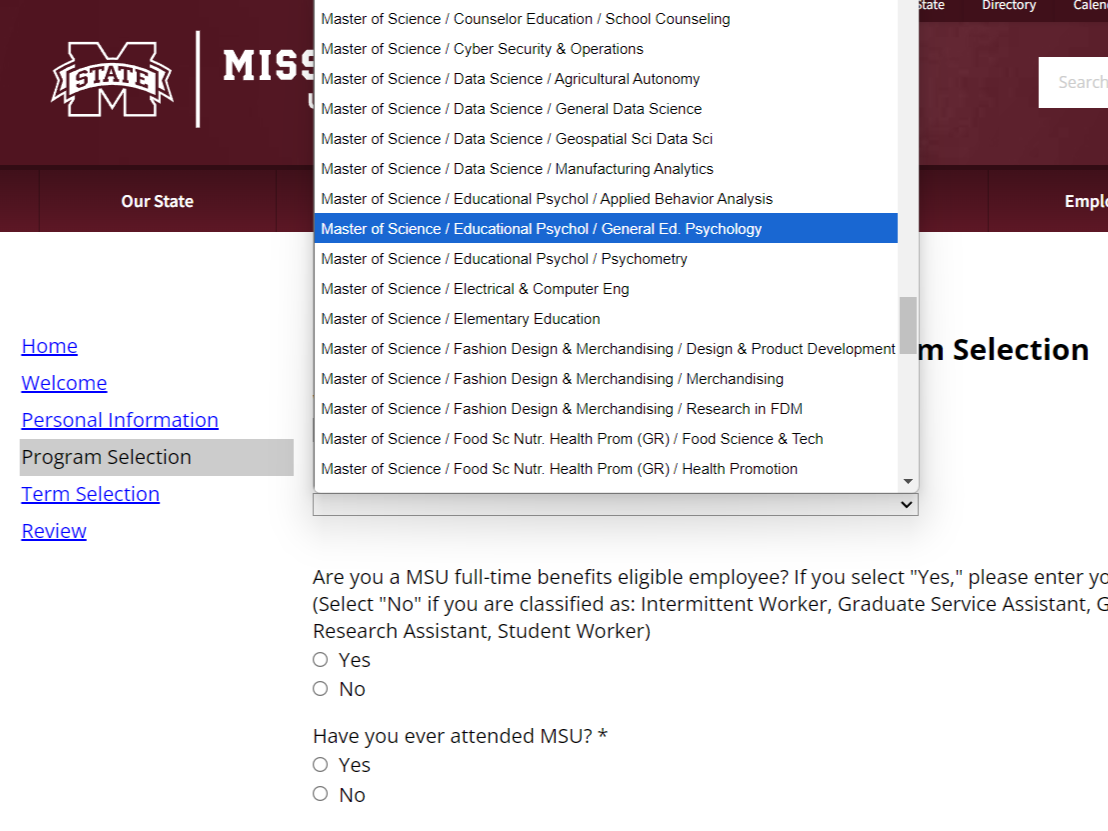
Applicants to the M.S. program must apply through the Graduate School. Completed applications are then reviewed by the Educational Psychology faculty admissions committee. When applying through the Graduate School website, select the "General Ed. Psychology" option from the drop-down menu (see screenshot below). Choosing another option means applying to a different program area, and application fees are not refundable.
Application Materials
The following materials are required by the Educational Psychology graduate programs:
- Personal Statement or Statement of Purpose
- Official transcripts from all universities attended
- Three letters of recommendation
- Resume or Vitae
- GRE scores (verbal reasoning, quantitative reasoning, and analytical writing) - Optional but strongly encouraged
- Other materials as required by the Graduate School (e.g., English test scores for international applicants)
Application Deadlines
The program admits students for fall semester only.
- Early Admission: January 15 (All applicants who apply by our early admission deadline are given full consideration for assistantships.)
- Regular Admission: July 1 (for domestic students) and April 1 (for international students)
Financial Assistance
Students in the M.S. and Ph.D. programs in Educational Psychology may receive financial assistance through assistantships.
Assistantships may be available from the department and via other related units on campus. Some students have obtained assistantships outside of the department in other areas including the Dean's Office, Student Support Services, Department of Human Sciences, Research Curriculum Unit, and Social Sciences Research Center.
If awarded, an assistantship includes a tuition waiver (both in-state and out-of-state tuition) and a monthly stipend depending on the placement. All "early admission" applicants are given full consideration for assistantships, but priority would be given to applicants for the Ph.D. program.
Students must be enrolled full-time (i.e., 9 credit hours) and complete 20 hours per week for each assistantship. For more information regarding university assistantships, visit the Office of Graduate Studies.
In addition to assistantships, some students apply for financial aid to assist them in meeting the financial demands of graduate school. To learn more about financial aid, visit the Office of Financial Aid.
For the most current information regarding tuition and fees, visit Account Services.
Career Opportunities
Educational psychology graduates are trained to answer a question every school, university, and educational organization needs answered: is this working, and how do we know? The M.S. curriculum builds that capacity deliberately: research design, statistics, measurement and testing, and a deep grounding in how people learn and what motivates them. Graduates carry those skills into academic support services, program evaluation, institutional research, assessment coordination, instructional design, and research administration.
Recent alumni have held positions such as:
- Instructional Support Team Supervisor
- Student-Athlete Development Coordinator
- Educational Specialist
- Assistant Director of Athletic Academic Support Services
A Foundation for Doctoral Study
This is also a program built to launch doctoral careers. Where many applied master's degrees offer a single statistics course, ours requires two, EPY 6214 and EPY 8214, alongside research methods and qualitative research. That is a genuine methodological foundation, and it shows in doctoral applications. Students who choose the thesis option go further still, designing and carrying out an independent study under faculty supervision. Several of our graduates have continued into doctoral programs in educational psychology.
The thesis decision is worth making early and deliberately. If doctoral study or research-oriented work is your goal, the thesis path gives you something to point to. If you are heading into practice, the non-thesis path gets you there more directly. Your advisor can help you weigh it in your first semester.
Experience While You Study
Assistantship placements (if awarded) put students to work across campus: the Dean's Office, Student Support Services, the Research Curriculum Unit, the Social Sciences Research Center. Students holding them graduate with two years of applied experience in educational research, assessment, or student support, and that experience is often what distinguishes them on the job market.
Throughout, our faculty work as mentors rather than lecturers, helping students shape research interests, develop teaching practice, and build the professional networks that outlast the degree.
Contact Information
Elaine Wei, Ph.D.
Professor of Educational Psychology
ewei@colled.msstate.edu